
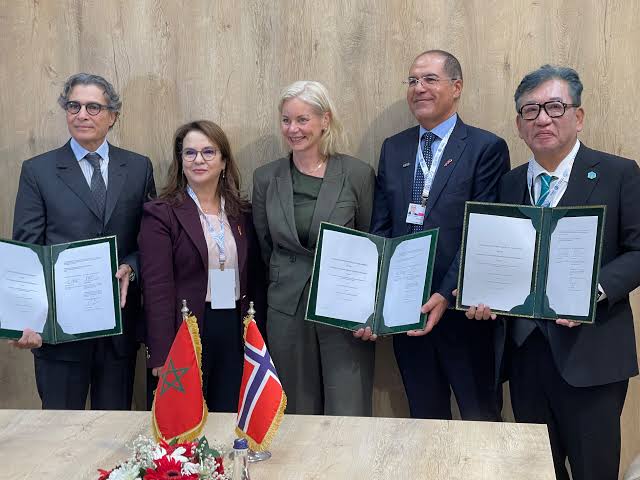
Morocco and Norway signed a Mitigation Outcome Purchase Agreement (MOPA) at COP31 in Antalya, Türkiye, on 12 November 2026. The arrangement, facilitated by the Global Green Growth Institute (GGGI), creates a route for Norway to purchase up to 8.78 million internationally transferred mitigation outcomes (ITMOs) generated between 2027 and 2036.
The agreement is designed to support Morocco’s Generation-Based Incentive (GBI) programme, which offers performance-based financial incentives to additional renewable-energy and battery-storage projects that would otherwise face economic or financing barriers. According to GGGI, the programme aims to mobilise approximately 2 GW of new renewable-energy capacity.
For investors, the significance extends beyond the headline carbon-credit volume. The transaction is a test of whether verified emissions reductions can provide an additional revenue stream that helps otherwise marginal energy projects reach financial viability.

How the carbon-credit mechanism works
Article 6.2 of the Paris Agreement allows countries to cooperate through the international transfer of authorised emissions-reduction outcomes. Under the Morocco–Norway arrangement, eligible projects must generate measurable mitigation results, which are then independently verified before payments are made. Morocco authorises the corresponding international transfers.
This is a results-based structure, not an upfront payment for all 8.78 million outcomes. The stated figure is a maximum purchase-and-transfer volume across the agreement period; it does not mean those outcomes have already been generated, verified or delivered.
The GBI programme seeks to bridge the gap between electricity-market revenues and the returns required to finance some renewable-energy investments. Additional carbon-linked payments could improve project economics where electricity sales alone are insufficient. The extent of that benefit will depend on the programme’s rules, verified performance, transaction costs and the commercial terms of individual projects.
Why storage matters
The programme explicitly includes battery storage alongside renewable generation. Storage can help shift electricity output into periods of higher demand and improve the usefulness of variable renewable energy to the grid. However, the value of storage depends on dispatch arrangements, market rules, capital costs and operational performance.
GGGI has not disclosed in its announcement a fixed carbon price, total purchase value, project-by-project allocation or a definitive list of funded projects. Those details are essential to evaluating the scale of financing support available to developers.
From bilateral cooperation to implementation
The agreement follows a multi-year policy process. GGGI began supporting Morocco’s Article 6 policy development in 2019. Morocco and Norway signed a memorandum of understanding at COP28 in December 2023, followed by a bilateral Article 6 agreement and term sheet in May 2026.
The next phase is operational. GGGI says the partners will finalise the GBI programme rulebook, establish monitoring, reporting and verification arrangements, and launch a pilot phase. The first mitigation outcomes are expected from 2028.
Morocco is targeting more than 52% renewable energy in installed electricity capacity by 2030. The GBI programme is intended to encourage projects beyond the existing trajectory, while supporting the country’s broader emissions-reduction commitments.
The investor questions
The agreement offers a potentially replicable model for African renewable-energy financing, but its commercial impact is not yet proven. Investors will want to know how developers qualify, whether carbon payments can be incorporated into lending assumptions, what verification costs apply, and how risks are allocated if expected mitigation outcomes are not delivered.
It will also matter whether carbon revenue supplements conventional power-purchase arrangements or materially changes the bankability of projects that otherwise would not proceed. Evidence will come from the first approved projects, financing structures and verified transfers—not from the maximum agreement volume alone.
ENERGY INVESTOR QUESTION™
Can internationally traded carbon revenues make African renewable-energy projects financeable when electricity revenues alone are insufficient?